طلاب
مفاهيم الرياضيات التطبيقية لغات 3 ثانوي 2026.. استعد للامتحان
يبحث الطلاب عن مفاهيم الرياضيات التطبيقية لغات 3 ثانوي 2026، لمرادعة المادة قبل الامتحان.
مفاهيم الرياضيات التطبيقية لغات لطلاب الثانوية العامة 2026
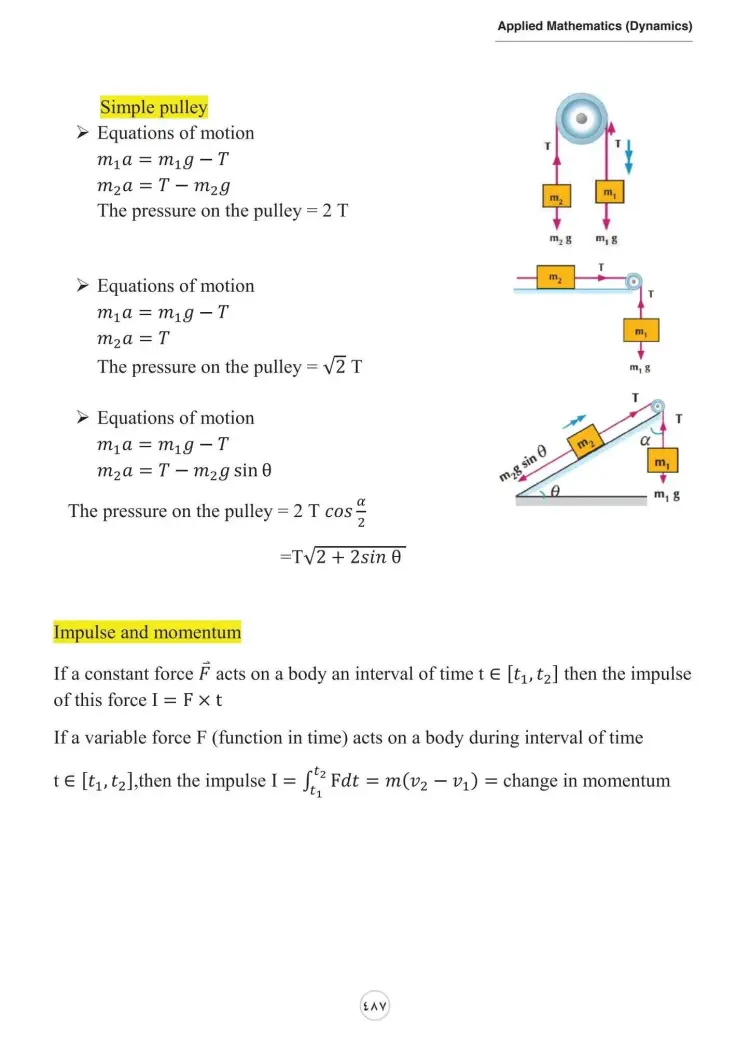
Applied Mathematics (Dynamics)
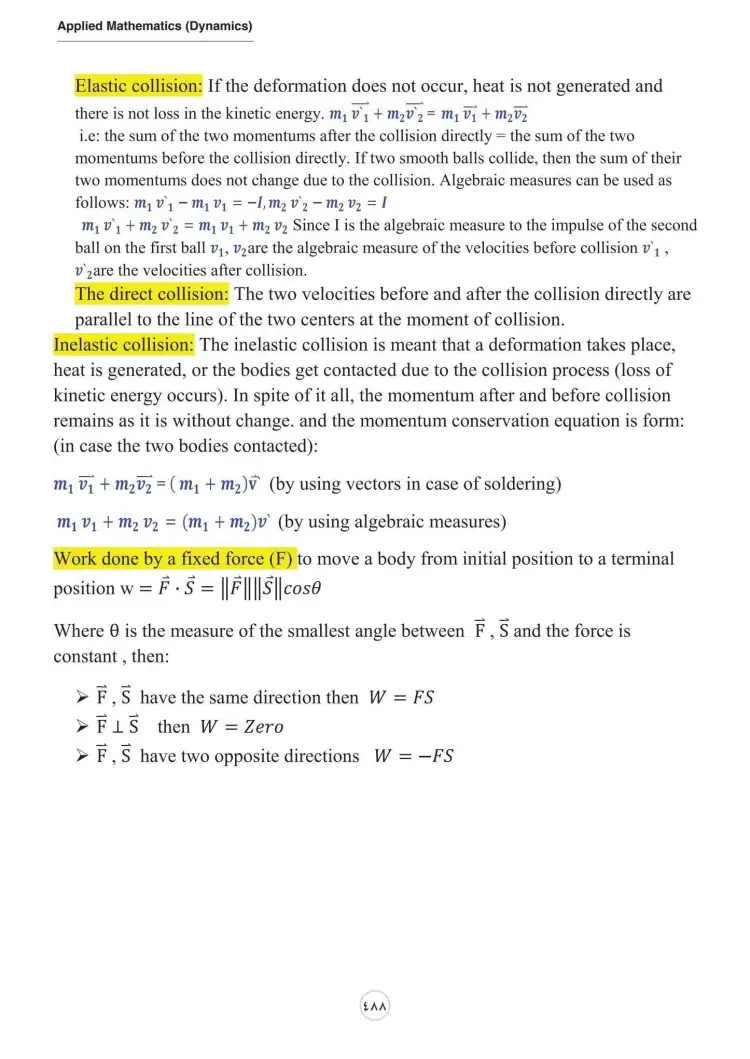
Elastic collision:
If the deformation does not occur, heat is not generated and there is not loss in the kinetic energy.
i.e: the sum of the two momentums after the collision directly = the sum of the two momentums before the collision directly. If two smooth balls collide, then the sum of their two momentums does not change due to the collision.
Algebraic measures can be used as follows:
The direct collision:
The two velocities before and after the collision directly are parallel to the line of the two centers at the moment of collision.
Inelastic collision:
The inelastic collision is meant that a deformation takes place, heat is generated, or the bodies get contacted due to the collision process (loss of kinetic energy occurs).
In spite of it all, the momentum after and before collision remains as it is without change. The momentum conservation equation is:
(in case the two bodies contacted)
m1v1⃗+m2v2⃗=(m1+m2)v⃗m_1\vec{v_1}+m_2\vec{v_2}=(m_1+m_2)\vec{v}m1v1+m2v2=(m1+m2)v
(by using vectors in case of soldering)
m1v1+m2v2=(m1+m2)vm_1v_1+m_2v_2=(m_1+m_2)vm1v1+m2v2=(m1+m2)v
(by using algebraic measures)
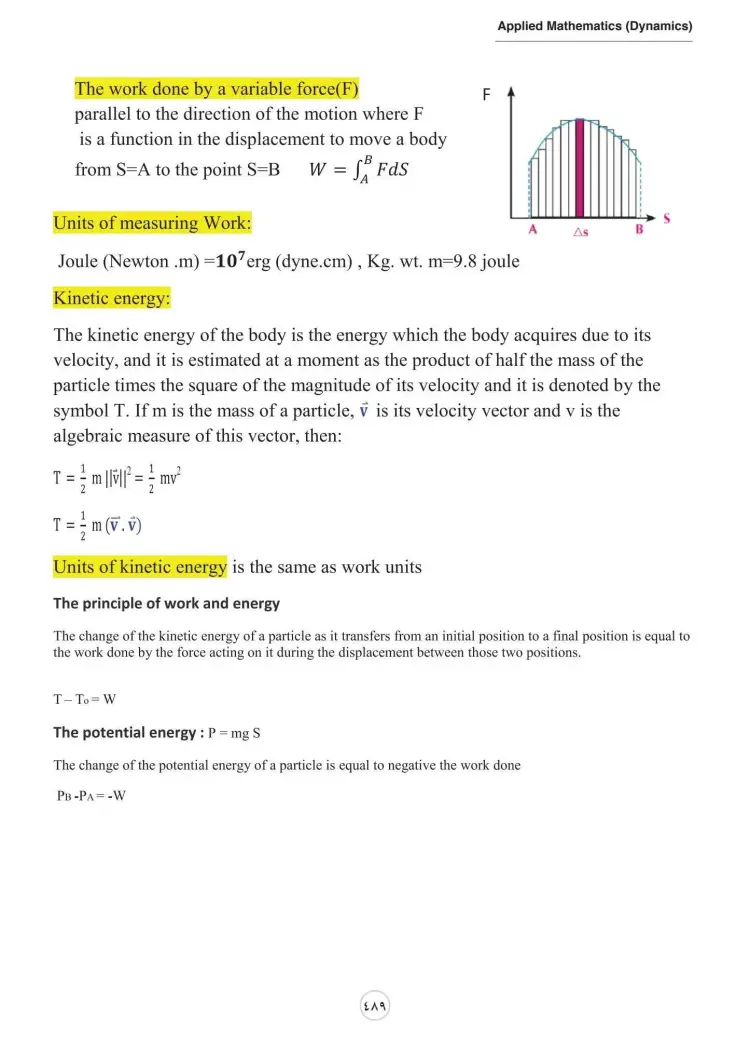
Work done by a fixed force (F)
to move a body from initial position to a terminal position
W=F⃗⋅S⃗=∣∣F⃗∣∣ ∣∣S⃗∣∣cosθW=\vec{F}\cdot\vec{S}=||\vec{F}||\,||\vec{S}||\cos\thetaW=F⋅S=∣∣F∣∣∣∣S∣∣cosθ
Where θ is the measure of the smallest angle between F⃗\vec{F}F, S⃗\vec{S}S and the force is constant, then:
- F⃗\vec{F}F, S⃗\vec{S}S have the same direction then
W=FSW=FSW=FS
- F⃗⊥S⃗\vec{F}\perp\vec{S}F⊥S then
W=ZeroW=ZeroW=Zero
- F⃗\vec{F}F, S⃗\vec{S}S have two opposite directions
W=−FSW=-FSW=−FS
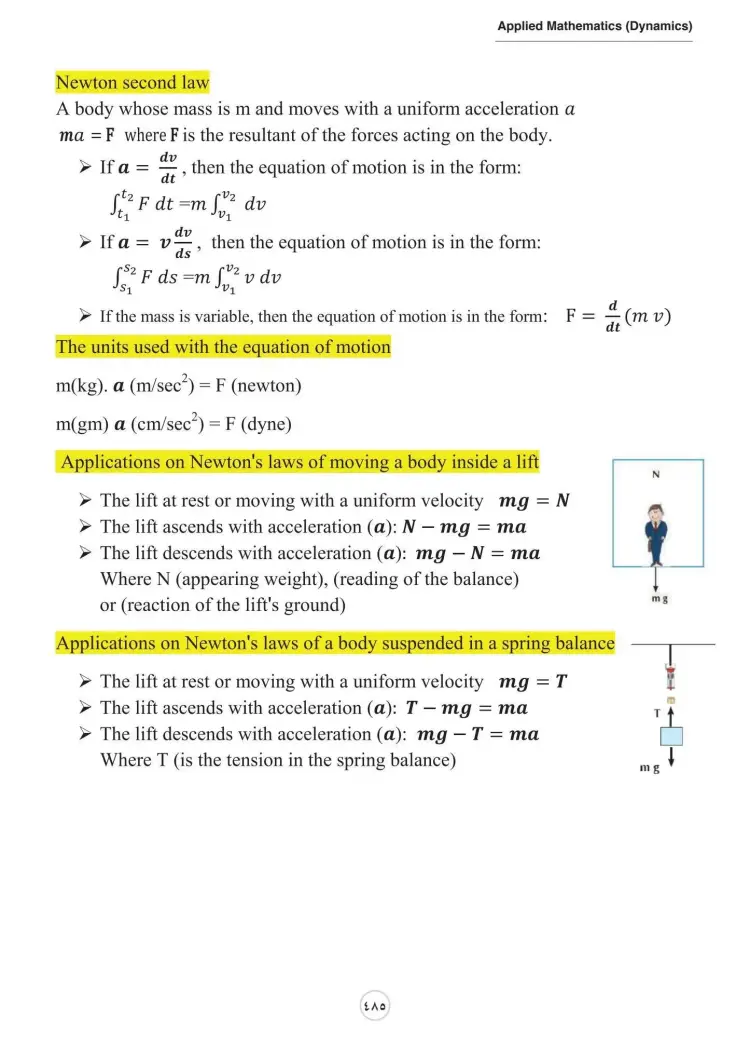
Applied Mathematics (Dynamics)
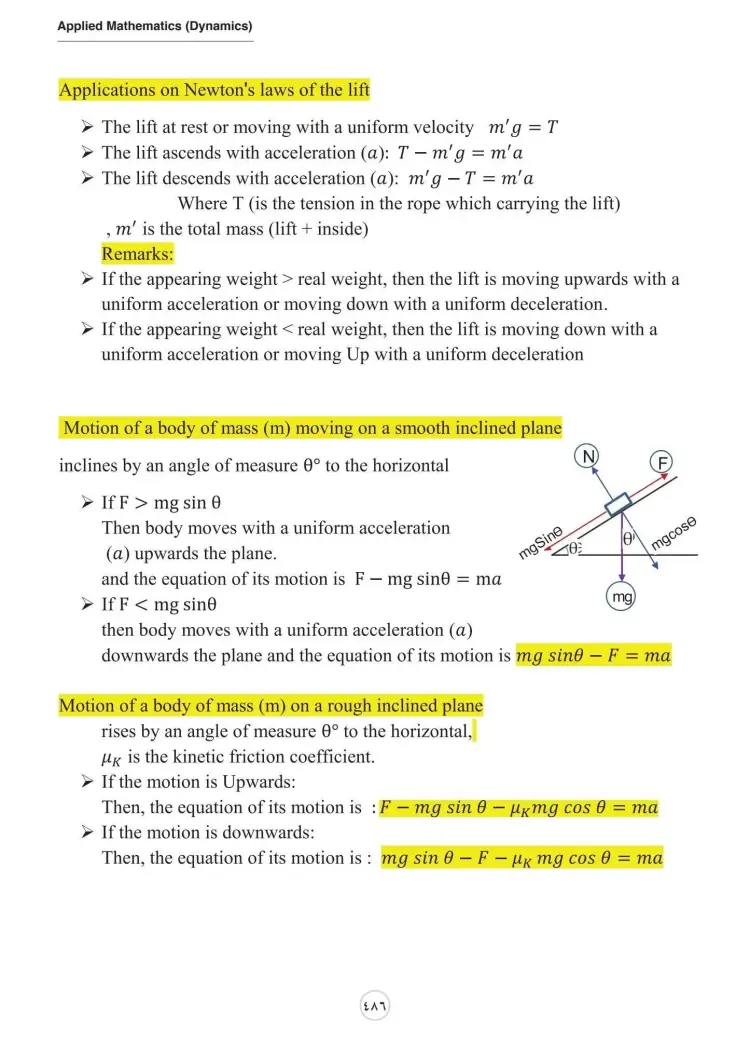
Applications on Newton's laws of the lift
- The lift at rest or moving with a uniform velocity
m′g=Tm'g=Tm′g=T
- The lift ascends with acceleration (a):
T−m′g=m′aT-m'g=m'aT−m′g=m′a
- The lift descends with acceleration (a):
m′g−T=m′am'g-T=m'am′g−T=m′a
Where T (is the tension in the rope which carrying the lift),
m′m'm′ is the total mass (lift + inside).
Remarks:
- If the appearing weight > real weight, then the lift is moving upwards with a uniform acceleration or moving down with a uniform deceleration.
- If the appearing weight < real weight, then the lift is moving down with a uniform acceleration or moving up with a uniform deceleration.
Motion of a body of mass (m) moving on a smooth inclined plane
inclines by an angle of measure θ° to the horizontal.
- If
F>mgsinθF>mg\sin\thetaF>mgsinθ
Then body moves with a uniform acceleration (a) upwards the plane.
The equation of its motion is
F−mgsinθ=maF-mg\sin\theta=maF−mgsinθ=ma
- If
F<mgsinθF<mg\sin\thetaF<mgsinθ
then body moves with a uniform acceleration (a) downwards the plane and the equation of its motion is
mgsinθ−F=mamg\sin\theta-F=mamgsinθ−F=ma
Motion of a body of mass (m) on a rough inclined plane
rises by an angle of measure θ° to the horizontal,
is the kinetic friction coefficient.
- If the motion is Upwards:
Then, the equation of its motion is:
F−mgsinθ−μkmgcosθ=maF-mg\sin\theta-\mu_kmg\cos\theta=maF−mgsinθ−μkmgcosθ=ma
- If the motion is downwards:
Then, the equation of its motion is:
mgsinθ−F−μkmgcosθ=mamg\sin\theta-F-\mu_kmg\cos\theta=mamgsinθ−F−μkmgcosθ=ma