تحضير الأسبوع السابع ساينس
تحضير الأسبوع السابع ساينس للصف الرابع والخامس والسادس الابتدائي الترم الأول 2027
يوفر موقع شبابيك تحضير الأسبوع السابع ساينس للصف الرابع والخامس والسادس الابتدائي الترم الأول 2027، لمساعدة المعلمين على وضع خطة التدريس التي سيتم اعتمادها خلال الأسبوع.
تحضير الأسبوع السابع ساينس للصف الرابع والخامس والسادس الابتدائي 2027
وفيما يلي تحضير الأسبوع السابع ساينس للصف الرابع والخامس والسادس الابتدائي الترم الأول 2027، والتي جاءت كما يلي
-
Date / Class / Present / Absent / Late / Remarks: (فارغ)
-
Supervisor's Signature: (فارغ)
-
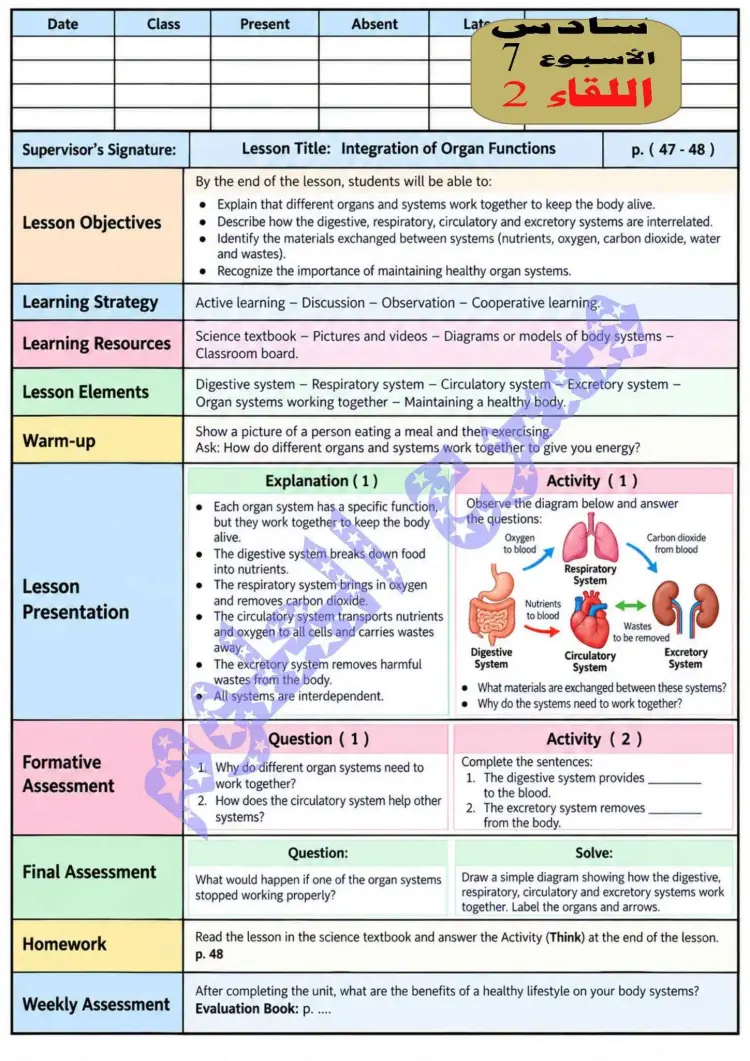
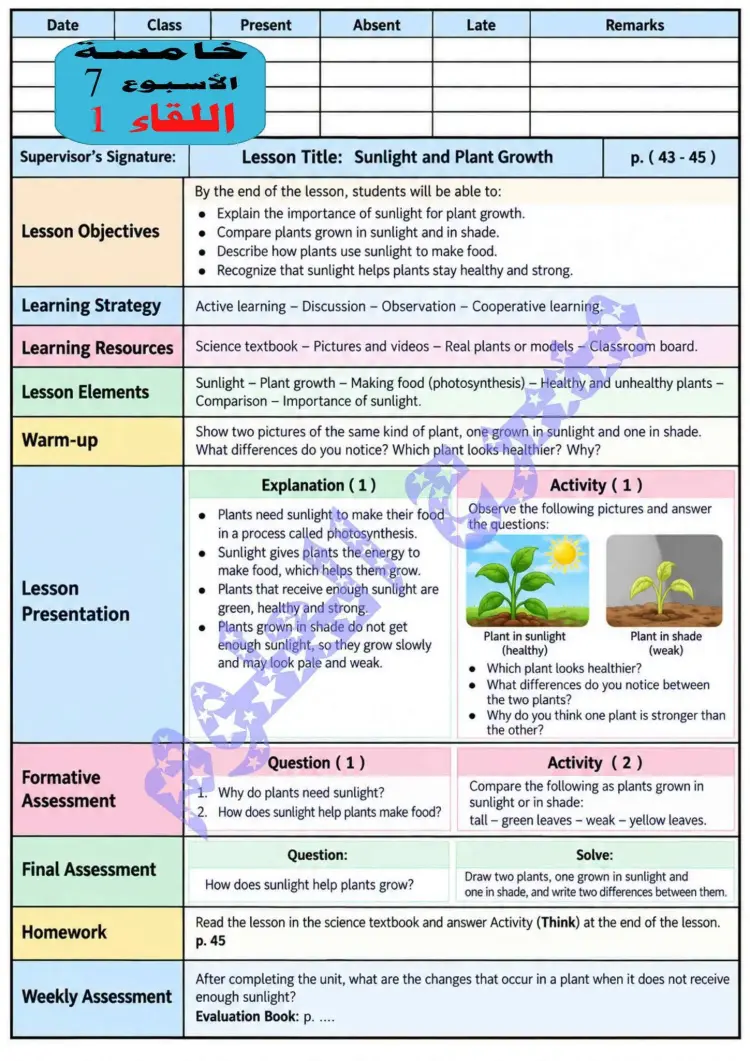
Lesson Title: Sunlight and Plant Growth
-
p. ( 43 - 45 ):
-
Lesson Objectives:
-
By the end of the lesson, students will be able to:
-
Explain the importance of sunlight for plant growth.
-
Compare plants grown in sunlight and in shade.
-
Describe how plants use sunlight to make food.
-
Recognize that sunlight helps plants stay healthy and strong.
-
-
Learning Strategy: Active learning - Discussion - Observation - Cooperative learning.
-
Learning Resources: Science textbook - Pictures and videos - Real plants or models - Classroom board.
-
Lesson Elements: Sunlight - Plant growth - Making food (photosynthesis) - Healthy and unhealthy plants - Comparison - Importance of sunlight.
-
Warm-up: Show two pictures of the same kind of plant, one grown in sunlight and one in shade. What differences do you notice? Which plant looks healthier? Why?
Lesson Presentation
-
Explanation ( 1 ):
-
Plants need sunlight to make their food in a process called photosynthesis.
-
Sunlight gives plants the energy to make food, which helps them grow.
-
Plants that receive enough sunlight are green, healthy and strong.
-
Plants grown in shade do not get enough sunlight, so they grow slowly and may look pale and weak.
-
-
Activity ( 1 ):
-
Observe the following pictures and answer the questions:
-
(صورة توضيحية: Plant in sunlight (healthy) / Plant in shade (weak))
-
Which plant looks healthier?
-
What differences do you notice between the two plants?
-
Why do you think one plant is stronger than the other?
-
-
Formative Assessment:
-
Question ( 1 ):
-
Why do plants need sunlight?
-
How does sunlight help plants make food?
-
-
Activity ( 2 ):
-
Compare the following as plants grown in sunlight or in shade:
-
tall - green leaves - weak - yellow leaves.
-
-
-
Final Assessment:
-
Question: How does sunlight help plants grow?
-
Solve: Draw two plants, one grown in sunlight and one in shade, and write two differences between them.
-
-
Homework: Read the lesson in the science textbook and answer Activity (Think) at the end of the lesson. p. 45
-
Weekly Assessment: After completing the unit, what are the changes that occur in a plant when it does not receive enough sunlight? Evaluation Book: p. ....
[سادس - الأسبوع 7]
-
Date / Class / Present / Absent / Late / Remarks: (فارغ)
-
Supervisor's Signature: (فارغ)
-
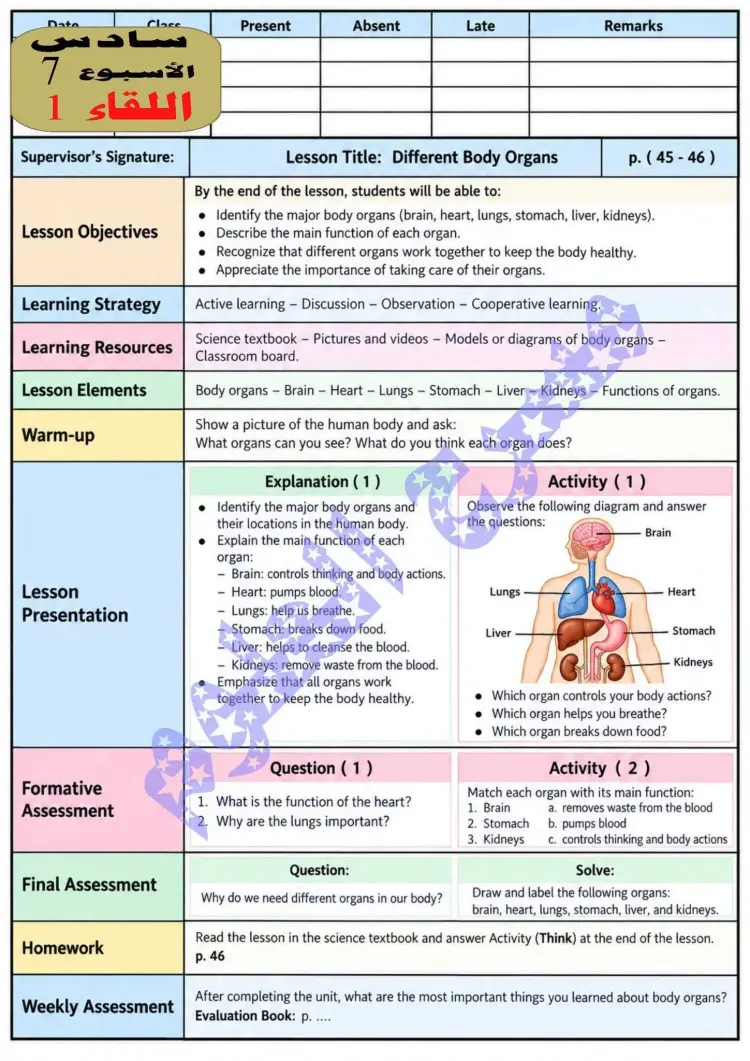
Lesson Title: Different Body Organs
-
p. ( 45 - 46 ):
-
Lesson Objectives:
-
By the end of the lesson, students will be able to:
-
Identify the major body organs (brain, heart, lungs, stomach, liver, kidneys).
-
Describe the main function of each organ.
-
Recognize that different organs work together to keep the body healthy.
-
Appreciate the importance of taking care of their organs.
-
-
Learning Strategy: Active learning - Discussion - Observation - Cooperative learning.
-
Learning Resources: Science textbook - Pictures and videos - Models or diagrams of body organs - Classroom board.
-
Lesson Elements: Body organs - Brain - Heart - Lungs - Stomach - Liver - Kidneys - Functions of organs.
-
Warm-up: Show a picture of the human body and ask: What organs can you see? What do you think each organ does?
Lesson Presentation
-
Explanation ( 1 ):
-
Identify the major body organs and their locations in the human body.
-
Explain the main function of each organ:
-
Brain: controls thinking and body actions.
-
Heart: pumps blood.
-
Lungs: help us breathe.
-
Stomach: breaks down food.
-
Liver: helps to cleanse the blood.
-
Kidneys: remove waste from the blood.
-
-
Emphasize that all organs work together to keep the body healthy.
-
-
Activity ( 1 ):
-
Observe the following diagram and answer the questions:
-
(رسم توضيحي لأعضاء الجسم: Brain, Lungs, Heart, Liver, Stomach, Kidneys)
-
Which organ controls your body actions?
-
Which organ helps you breathe?
-
Which organ breaks down food?
-
-
Formative Assessment:
-
Question ( 1 ):
-
What is the function of the heart?
-
Why are the lungs important?
-
-
Activity ( 2 ):
-
Match each organ with its main function:
-
-
Brain \quad a. removes waste from the blood
-
-
-
Stomach \quad b. pumps blood
-
-
-
Kidneys \quad c. controls thinking and body actions
-
-
-
-
Final Assessment:
-
Question: Why do we need different organs in our body?
-
Solve: Draw and label the following organs: brain, heart, lungs, stomach, liver, and kidneys.
-
-
Homework: Read the lesson in the science textbook and answer Activity (Think) at the end of the lesson. p. 46
-
Weekly Assessment: After completing the unit, what are the most important things you learned about body organs? Evaluation Book: p. ....