ساينس
تحضير الأسبوع السادس ساينس للمرحلة الإعدادي الترم الأول 2027
يبحث المعلمين عن تحضير الأسبوع السادس ساينس للمرحلة الإعدادي الترم الأول 2027، لتحديد الأجزاء التي سيتم شرحها للطلاب خلال الأسبوع.
تحضير الأسبوع السادس ساينس للمرحلة الإعدادي الترم الأول 2027
Prep 2 (Grade 8) - Week 6 - Meeting 1
-
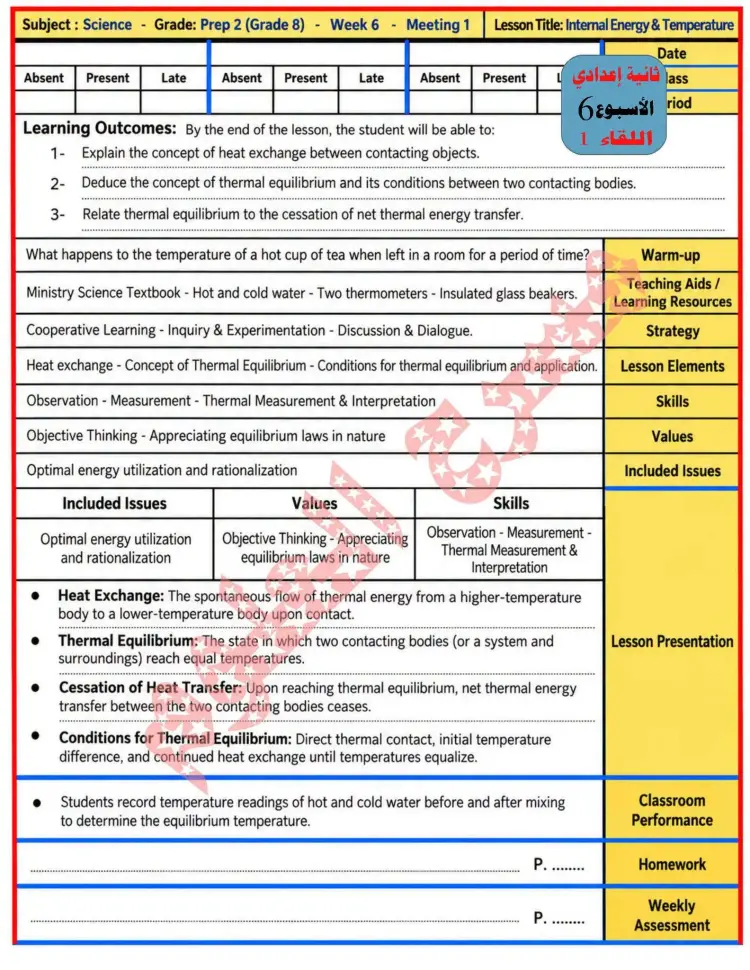
المادة / الصف: Science - Prep 2 (Grade 8)
-
الأسبوع / اللقاء: Week 6 - Meeting 1 (ثانية إعدادي - الأسبوع 6 - اللقاء 1)
-
عنوان الدرس (Lesson Title): Internal Energy & Temperature
نواتج التعلم (Learning Outcomes)
By the end of the lesson, the student will be able to:
-
Explain the concept of heat exchange between contacting objects.
-
Deduce the concept of thermal equilibrium and its conditions between two contacting bodies.
-
Relate thermal equilibrium to the cessation of net thermal energy transfer.
تفاصيل التحضير (Lesson Details)
-
التهيئة (Warm-up): What happens to the temperature of a hot cup of tea when left in a room for a period of time?
-
الوسائل التعليمية / مصادر التعلم (Teaching Aids / Learning Resources): Ministry Science Textbook - Hot and cold water - Two thermometers - Insulated glass beakers.
-
الاستراتيجية (Strategy): Cooperative Learning - Inquiry & Experimentation - Discussion & Dialogue.
-
عناصر الدرس (Lesson Elements): Heat exchange - Concept of Thermal Equilibrium - Conditions for thermal equilibrium and application.
| Skills (المهارات) | Values (القيم) | Included Issues (القضايا المتضمنة) |
|---|---|---|
| Observation - Measurement - Thermal Measurement & Interpretation | Objective Thinking - Appreciating equilibrium laws in nature | Optimal energy utilization and rationalization |
عرض الدرس (Lesson Presentation)
-
Heat Exchange: The spontaneous flow of thermal energy from a higher-temperature body to a lower-temperature body upon contact.
-
Thermal Equilibrium: The state in which two contacting bodies (or a system and surroundings) reach equal temperatures.
-
Cessation of Heat Transfer: Upon reaching thermal equilibrium, net thermal energy transfer between the two contacting bodies ceases.
-
Conditions for Thermal Equilibrium: Direct thermal contact, initial temperature difference, and continued heat exchange until temperatures equalize.
الأنشطة والتقييمات (Assessments & Activities)
-
الأداء الصفي (Classroom Performance): Students record temperature readings of hot and cold water before and after mixing to determine the equilibrium temperature.
-
الواجب المنزلي (Homework): P. ........
-
التقييم الأسبوعي (Weekly Assessment): P. ........
Prep 1 - Week 6 - Meeting 2
-
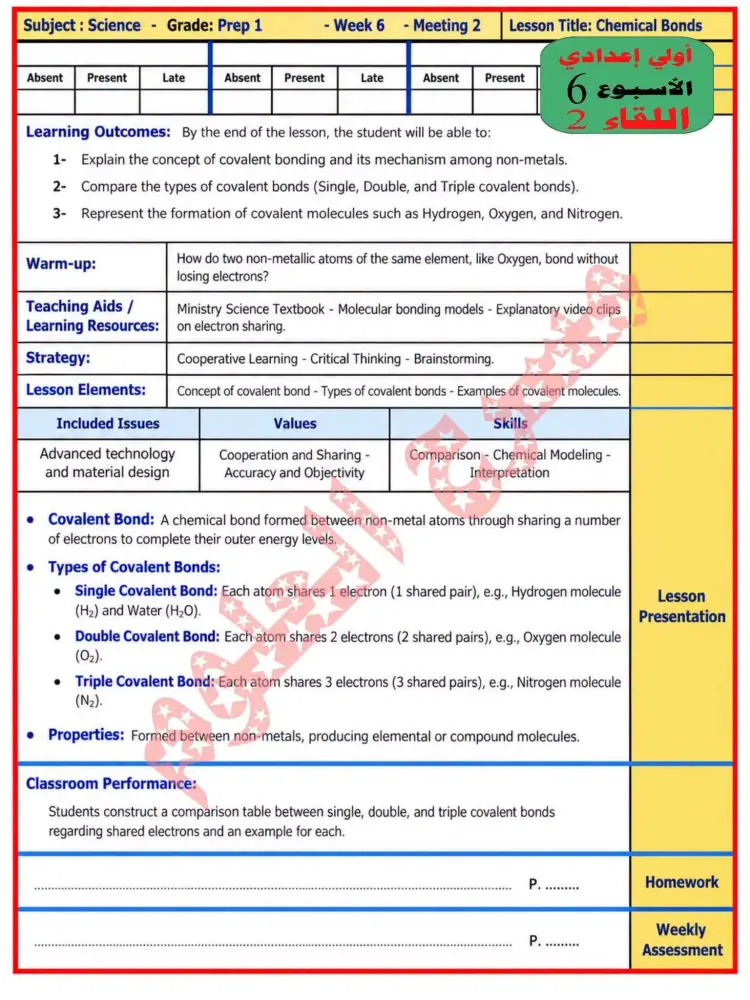
المادة / الصف: Science - Prep 1
-
الأسبوع / اللقاء: Week 6 - Meeting 2 (أولى إعدادي - الأسبوع 6 - اللقاء 2)
-
عنوان الدرس (Lesson Title): Chemical Bonds
نواتج التعلم (Learning Outcomes)
By the end of the lesson, the student will be able to:
-
Explain the concept of covalent bonding and its mechanism among non-metals.
-
Compare the types of covalent bonds (Single, Double, and Triple covalent bonds).
-
Represent the formation of covalent molecules such as Hydrogen, Oxygen, and Nitrogen.
تفاصيل التحضير (Lesson Details)
-
التهيئة (Warm-up): How do two non-metallic atoms of the same element, like Oxygen, bond without losing electrons?
-
الوسائل التعليمية / مصادر التعلم (Teaching Aids / Learning Resources): Ministry Science Textbook - Molecular bonding models - Explanatory video clips on electron sharing.
-
الاستراتيجية (Strategy): Cooperative Learning - Critical Thinking - Brainstorming.
-
عناصر الدرس (Lesson Elements): Concept of covalent bond - Types of covalent bonds - Examples of covalent molecules.
| Skills (المهارات) | Values (القيم) | Included Issues (القضايا المتضمنة) |
|---|---|---|
| Comparison - Chemical Modeling - Interpretation | Cooperation and Sharing - Accuracy and Objectivity | Advanced technology and material design |
عرض الدرس (Lesson Presentation)
-
Covalent Bond: A chemical bond formed between non-metal atoms through sharing a number of electrons to complete their outer energy levels.
-
Types of Covalent Bonds:
-
Single Covalent Bond: Each atom shares 1 electron (1 shared pair), e.g., Hydrogen molecule (H2\text{H}_2H2) and Water (H2O\text{H}_2\text{O}H2O).
-
Double Covalent Bond: Each atom shares 2 electrons (2 shared pairs), e.g., Oxygen molecule (O2\text{O}_2O2).
-
Triple Covalent Bond: Each atom shares 3 electrons (3 shared pairs), e.g., Nitrogen molecule (N2\text{N}_2N2).
-
-
Properties: Formed between non-metals, producing elemental or compound molecules.
الأنشطة والتقييمات (Assessments & Activities)
-
الأداء الصفي (Classroom Performance): Students construct a comparison table between single, double, and triple covalent bonds regarding shared electrons and an example for each.
-
الواجب المنزلي (Homework): P. ........
-
التقييم الأسبوعي (Weekly Assessment): P. ........