حل الوحدة الرابعة انجليزي للصف الخامس الابتدائي الترم الأول 2027
حل الوحدة الرابعة انجليزي للصف الخامس الابتدائي الترم الأول 2027
يوفر شبابيك للطلاب وأولياء الأمور حل الوحدة الرابعة انجليزي للصف الخامس الابتدائي الترم الأول 2027، لمساعدة الطلاب على الوصول للإجابات النموذجية للأسئلة.
حل الوحدة الرابعة انجليزي للصف الخامس الابتدائي 2027
وفيما يلي حل الوحدة الرابعة انجليزي للصف الخامس الابتدائي الترم الأول 2027، والتي جاءت كما يلي
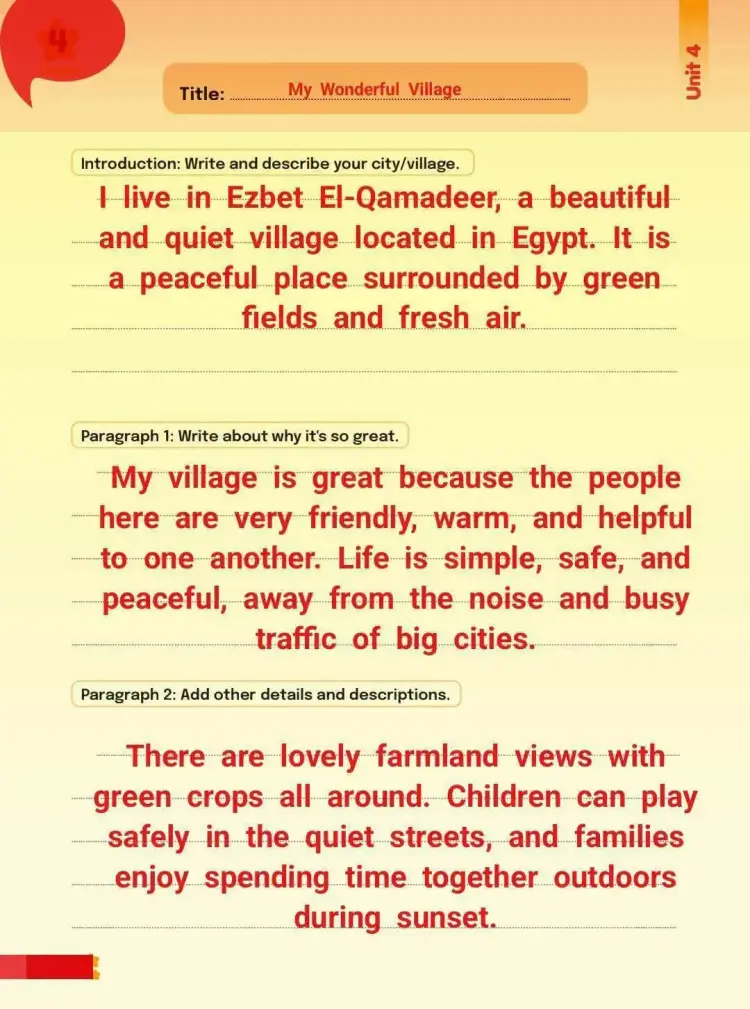
Unit 4Lesson 4Title: My Wonderful Village
-
Introduction: Write and describe your city/village.
-
I live in Ezbet El-Qamadeer, a beautiful and quiet village located in Egypt. It is a peaceful place surrounded by green fields and fresh air.
-
-
Paragraph 1: Write about why it's so great.
-
My village is great because the people here are very friendly, warm, and helpful to one another. Life is simple, safe, and peaceful, away from the noise and busy traffic of big cities.
-
-
Paragraph 2: Add other details and descriptions.
-
There are lovely farmland views with green crops all around. Children can play safely in the quiet streets, and families enjoy spending time together outdoors during sunset.
-
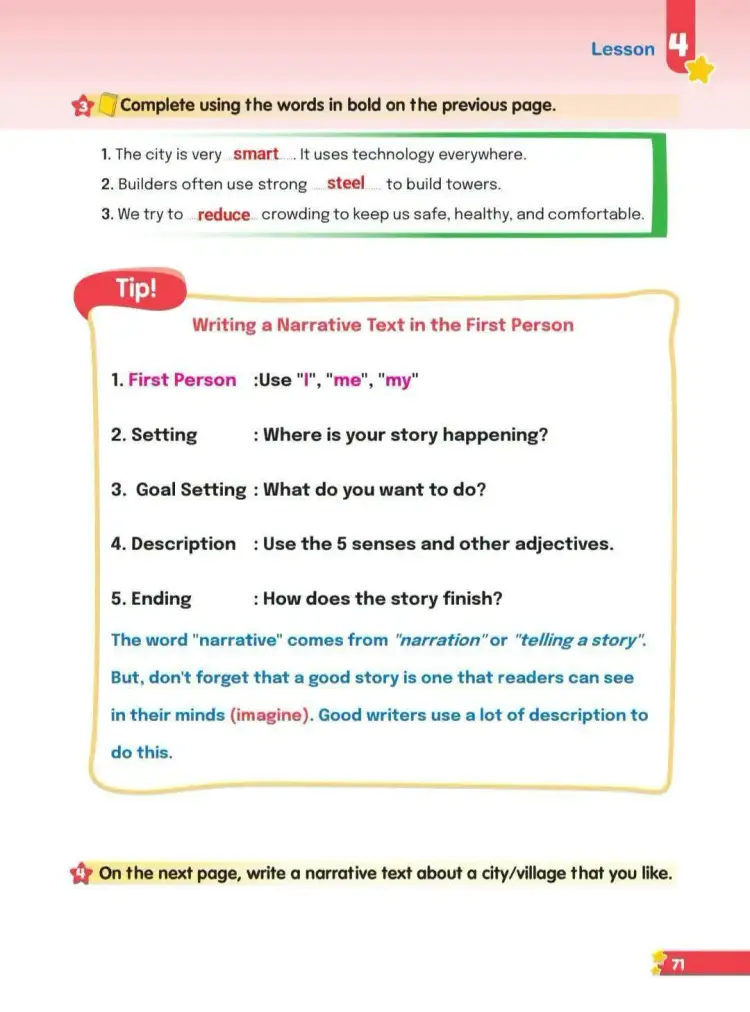
Lesson 4
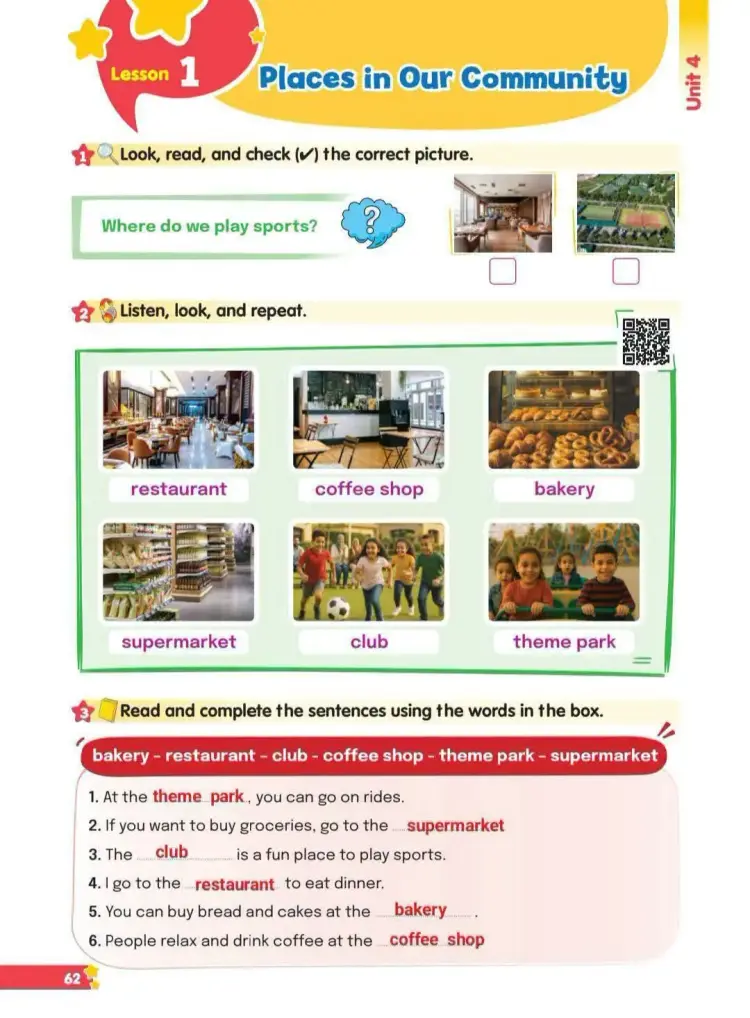
3. Complete using the words in bold on the previous page.
-
The city is very smart. It uses technology everywhere.
-
Builders often use strong steel to build towers.
-
We try to reduce crowding to keep us safe, healthy, and comfortable.
Tip!Writing a Narrative Text in the First Person
-
First Person: Use "I", "me", "my"
-
Setting: Where is your story happening?
-
Goal Setting: What do you want to do?
-
Description: Use the 5 senses and other adjectives.
-
Ending: How does the story finish?
The word "narrative" comes from "narration" or "telling a story". But, don't forget that a good story is one that readers can see in their minds (imagine). Good writers use a lot of description to do this.
-
On the next page, write a narrative text about a city/village that you like.
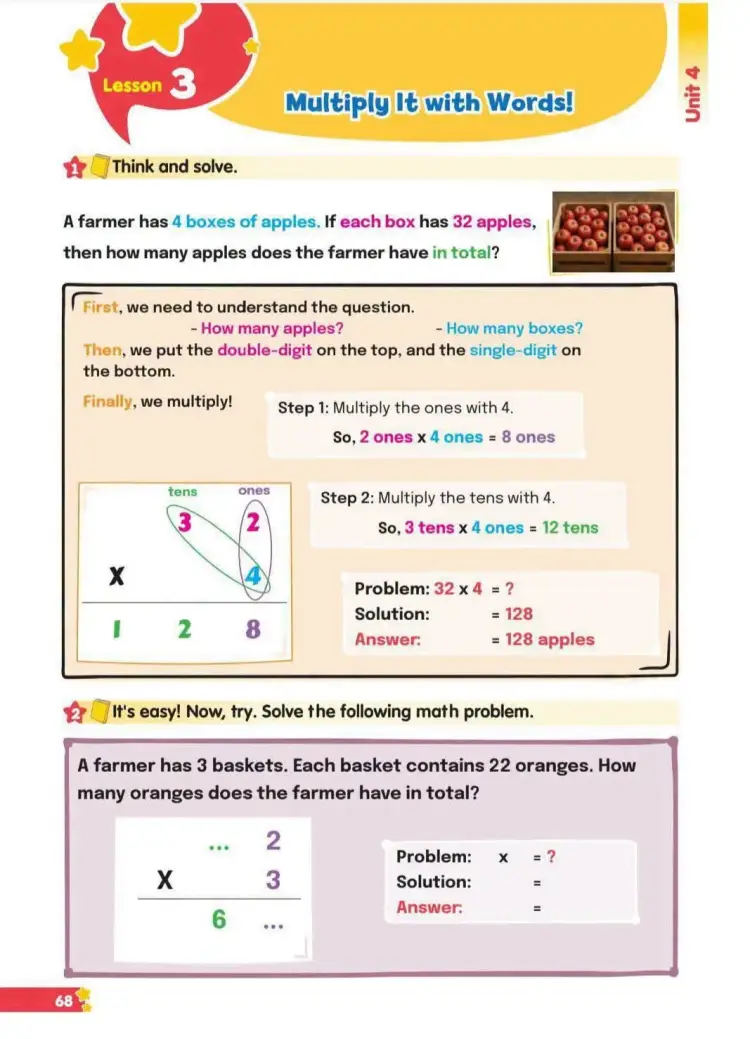
Unit 4Lesson 3Multiply It with Words!
Think and solve. A farmer has 4 boxes of apples. If each box has 32 apples, then how many apples does the farmer have in total?
-
First, we need to understand the question.
-
How many apples? ←\leftarrow← How many boxes?
-
-
Then, we put the double-digit on the top, and the single-digit on the bottom.
-
Finally, we multiply!
-
Step 1: Multiply the ones with 4. So, 2 ones ×\times× 4 ones = 8 ones
-
Step 2: Multiply the tens with 4. So, 3 tens ×\times× 4 ones = 12 tens
-
-
Problem: 32×4=?32 \times 4 = ?32×4=?
-
Solution: =128= 128=128
-
Answer: =128= 128=128 apples
It's easy! Now, try. Solve the following math problem. A farmer has 3 baskets. Each basket contains 22 oranges. How many oranges does the farmer have in total?
-
Problem: ⋯×⋯=?\dots \times \dots = ?⋯×⋯=?
-
Solution: ⋯=…\dots = \dots⋯=…
-
Answer: ⋯=…\dots = \dots⋯=…
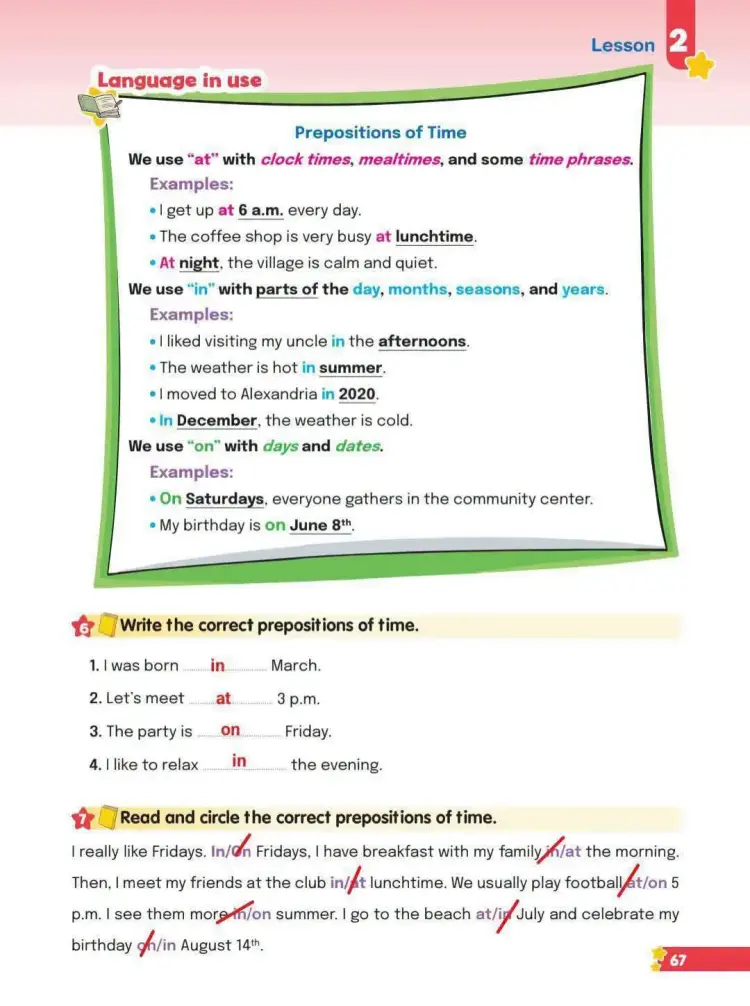
Lesson 2Language in use
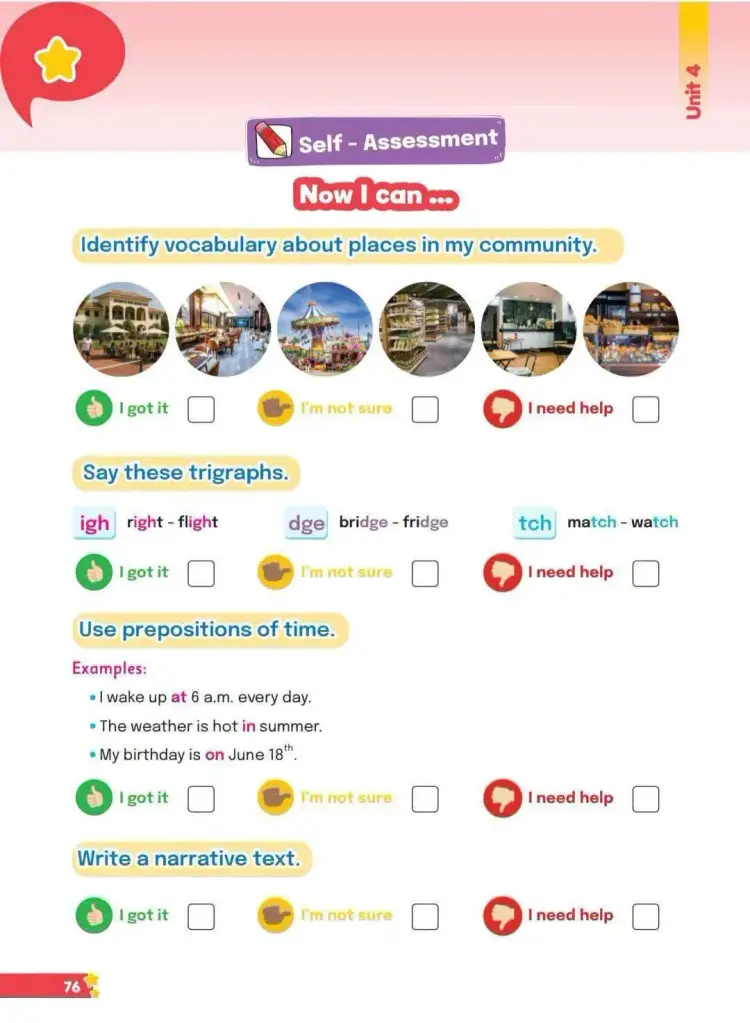
Prepositions of Time We use "at" with clock times, mealtimes, and some time phrases.
-
Examples:
-
I get up at 6 a.m. every day.
-
The coffee shop is very busy at lunchtime.
-
At night, the village is calm and quiet.
-
We use "in" with parts of the day, months, seasons, and years.
-
Examples:
-
I liked visiting my uncle in the afternoons.
-
The weather is hot in summer.
-
I moved to Alexandria in 2020.
-
In December, the weather is cold.
-
We use "on" with days and dates.
-
Examples:
-
On Saturdays, everyone gathers in the community center.
-
My birthday is on June 8th.
-
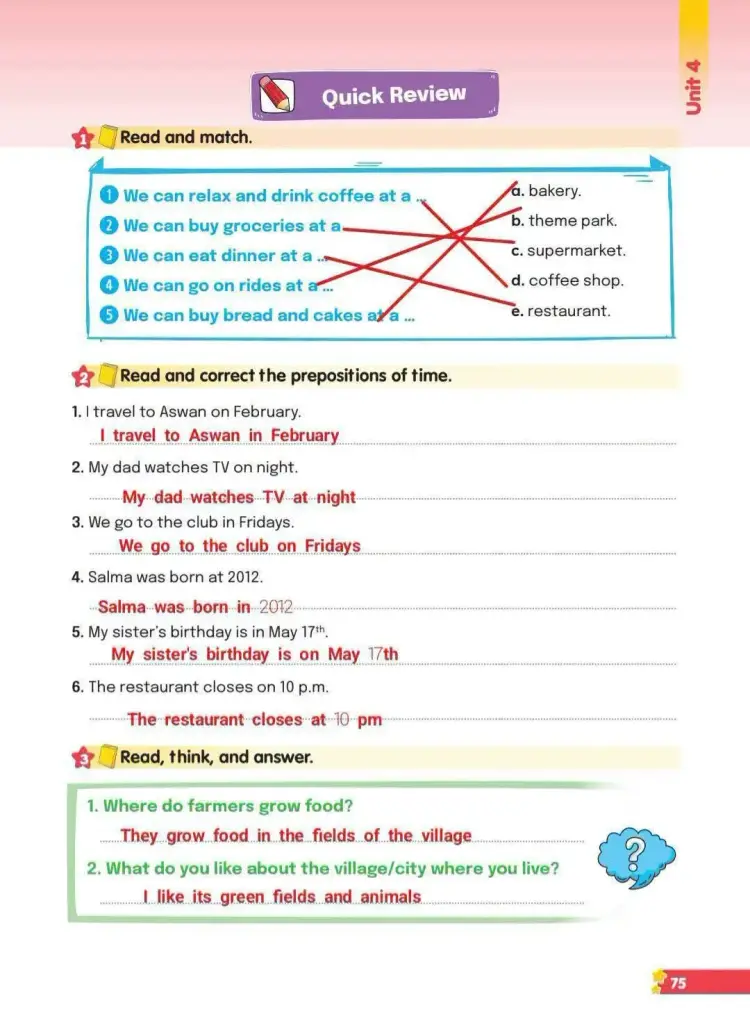
6. Write the correct prepositions of time.
-
I was born in March.
-
Let's meet at 3 p.m.
-
The party is on Friday.
-
I like to relax in the evening.
7. Read and circle the correct prepositions of time. I really like Fridays. On Fridays, I have breakfast with my family in the morning. Then, I meet my friends at the club at lunchtime. We usually play football at 5 p.m. I see them more in summer. I go to the beach in July and celebrate my birthday on August 14th.
Unit 4Lesson 2
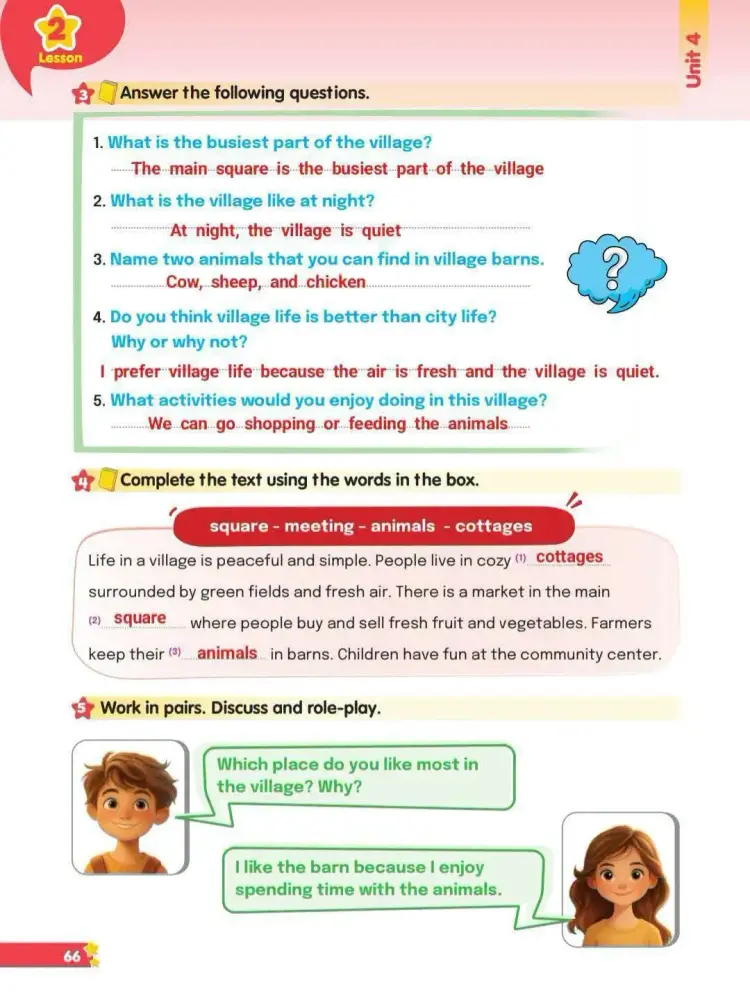
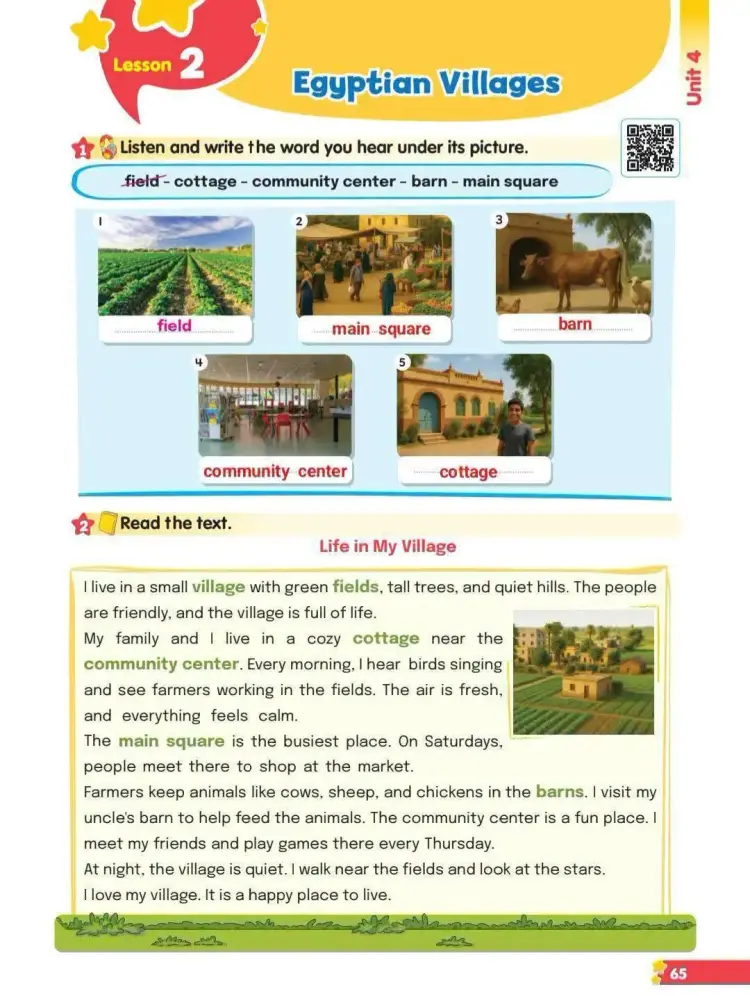
3. Answer the following questions.
-
What is the busiest part of the village?
-
The main square is the busiest part of the village
-
-
What is the village like at night?
-
At night, the village is quiet
-
-
Name two animals that you can find in village barns.
-
Cow, sheep, and chicken
-
-
Do you think village life is better than city life? Why or why not?
-
I prefer village life because the air is fresh and the village is quiet.
-
-
What activities would you enjoy doing in this village?
-
We can go shopping or feeding the animals.
-
4. Complete the text using the words in the box.(square - meeting - animals - cottages) Life in a village is peaceful and simple. People live in cozy (1)^{(1)}(1) cottages surrounded by green fields and fresh air. There is a market in the main (2)^{(2)}(2) square where people buy and sell fresh fruit and vegetables. Farmers keep their (3)^{(3)}(3) animals in barns. Children have fun at the community center.
5. Work in pairs. Discuss and role-play.
-
Question: Which place do you like most in the village? Why?
-
Answer: I like the barn because I enjoy spending time with the animals.
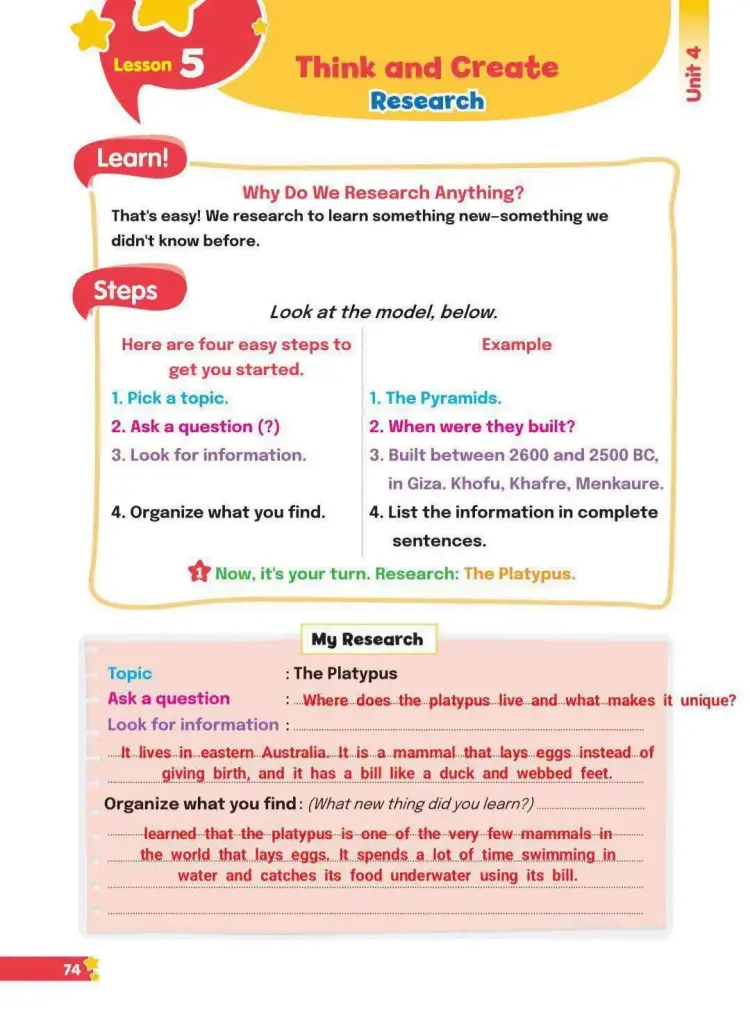
Unit 4Lesson 5Think and Create Research
Learn!Why Do We Research Anything? That's easy! We research to learn something new–something we didn't know before.
Steps: Look at the model, below. Here are four easy steps to get you started:
-
Pick a topic.
-
Ask a question (?)
-
Look for information.
-
Organize what you find.
Example:
-
The Pyramids.
-
When were they built?
-
Built between 2600 and 2500 BC, in Giza. Khofu, Khafre, Menkaure.
-
List the information in complete sentences.
-
Now, it's your turn. Research: The Platypus.
My Research
-
Topic: The Platypus
-
Ask a question: Where does the platypus live and what makes it unique?
-
Look for information: It lives in eastern Australia. It is a mammal that lays eggs instead of giving birth, and it has a bill like a duck and webbed feet.
-
Organize what you find: (What new thing did you learn?) I learned that the platypus is one of the very few mammals in the world that lays eggs. It spends a lot of time swimming in water and catches its food underwater using its bill.