طلاب
أسئلة القصة من النماذج الاسترشادية لمادة الإنجليزي للصف الثالث الثانوى 2026
يبحث الطلاب عن أسئلة القصة من النماذج الاسترشادية لمادة الإنجليزي للصف الثالث الثانوى 2026، لمعرفة شكل الأسئلة والاستعداد للامتحان.
أسئلة القصة من النماذج الاسترشادية لمادة الإنجليزي
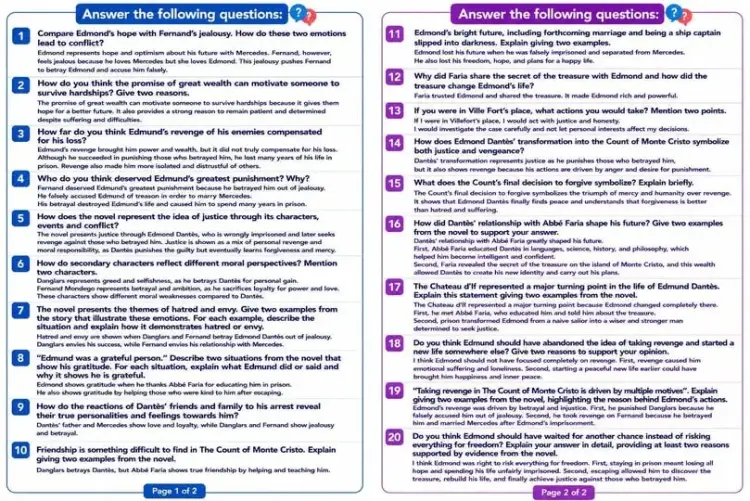
1. Compare Edmond's hope with Fernand's jealousy. How do these two emotions lead to conflict?
-
Answer: Edmond represents hope and optimism about his future with Mercedes. Fernand, however, feels jealous because he loves Mercedes but she loves Edmond. This jealousy pushes Fernand to betray Edmond and accuse him falsely.
2. How do you think the promise of great wealth can motivate someone to survive hardships? Give two reasons.
-
Answer: The promise of great wealth can motivate someone to survive hardships because it gives them hope for a better future. It also provides a strong reason to remain patient and determined despite suffering and difficulties.
3. How far do you think Edmond's revenge of his enemies compensated for his loss?
-
Answer: Edmond's revenge brought him power and wealth, but it did not truly compensate for his loss. Although he succeeded in punishing those who betrayed him, he lost many years of his life in prison. Revenge also made him more isolated and distrustful of others.
4. Who do you think deserved Edmond's greatest punishment? Why?
-
Answer: Fernand deserved Edmond's greatest punishment because he betrayed him out of jealousy. He falsely accused Edmond of treason in order to marry Mercedes. His betrayal destroyed Edmond's life and caused him to spend many years in prison.
5. How does the novel represent the idea of justice through its characters, events and conflict?
-
Answer: The novel presents justice through Edmond Dantès, who is wrongly imprisoned and later seeks revenge against those who betrayed him. Justice is shown as a mix of personal revenge and moral responsibility, as Dantès punishes the guilty but eventually learns forgiveness and mercy.
6. How do secondary characters reflect different moral perspectives? Mention two characters.
-
Answer: Danglars represents greed and selfishness, as he betrays Dantès for personal gain. Fernand Mondego represents betrayal and ambition, as he sacrifices loyalty for power and love. These characters show different moral weaknesses compared to Dantès.
7. The novel presents the themes of hatred and envy. Give two examples from the story that illustrate these emotions. For each example, describe the situation and explain how it demonstrates hatred or envy.
-
Answer: Hatred and envy are shown when Danglars and Fernand betray Edmond Dantès out of jealousy. Danglars envies his success, while Fernand envies his relationship with Mercedes.
8. "Edmond was a grateful person." Describe two situations from the novel that show his gratitude. For each situation, explain what Edmond did or said and why it shows he is grateful.
-
Answer: Edmond shows gratitude when he thanks Abbé Faria for educating him in prison. He also shows gratitude by helping those who were kind to him after escaping.
9. How do the reactions of Dantès' friends and family to his arrest reveal their true personalities and feelings towards him?
-
Answer: Dantès' father and Mercedes show love and loyalty, while Danglars and Fernand show jealousy and betrayal.
10. Friendship is something difficult to find in The Count of Monte Cristo. Explain giving two examples from the novel.
-
Answer: Danglars betrays Dantès, but Abbé Faria shows true friendship by helping and teaching him.
11. Edmond's bright future, including forthcoming marriage and being a ship captain slipped into darkness. Explain giving two examples.
-
Answer: Edmond lost his future when he was falsely imprisoned and separated from Mercedes. He also lost his freedom, hope, and plans for a happy life.
12. Why did Faria share the secret of the treasure with Edmond and how did the treasure change Edmond's life?
-
Answer: Faria trusted Edmond and shared the treasure. It made Edmond rich and powerful.
13. If you were in Ville Fort's place, what actions you would take? Mention two points.
-
Answer: If I were in Villefort's place, I would act with justice and honesty. I would investigate the case carefully and not let personal interests affect my decisions.
14. How does Edmond Dantès' transformation into the Count of Monte Cristo symbolize both justice and vengeance?
-
Answer: Dantès' transformation represents justice as he punishes those who betrayed him, but it also shows revenge because his actions are driven by anger and desire for punishment.
15. What does the Count's final decision to forgive symbolize? Explain briefly.
-
Answer: The Count's final decision to forgive symbolizes the triumph of mercy and humanity over revenge. It shows that Edmond Dantès finally finds peace and understands that forgiveness is better than hatred and suffering.
16. How did Dantès' relationship with Abbé Faria shape his future? Give two examples from the novel to support your answer.
-
Answer: Dantès' relationship with Abbé Faria greatly shaped his future. First, Abbé Faria educated Dantès in languages, science, history, and philosophy, which helped him become intelligent and confident. Second, Faria revealed the secret of the treasure on the island of Monte Cristo, and this wealth allowed Dantès to create his new identity and carry out his plans.
17. The Chateau d'If represented a major turning point in the life of Edmond Dantès. Explain this statement giving two examples from the novel.
-
Answer: The Chateau d'If represented a major turning point because Edmond changed completely there. First, he met Abbé Faria, who educated him and told him about the treasure. Second, prison transformed Edmond from a naive sailor into a wiser and stronger man determined to seek justice.
18. Do you think Edmond should have abandoned the idea of taking revenge and started a new life somewhere else? Give two reasons to support your opinion.
-
Answer: I think Edmond should not have focused completely on revenge. First, revenge caused him emotional suffering and loneliness. Second, starting a peaceful new life earlier could have brought him happiness and inner peace.
19. "Taking revenge in The Count of Monte Cristo is driven by multiple motives". Explain giving two examples from the novel, highlighting the reason behind Edmond's actions.
-
Answer: Edmond's revenge was driven by betrayal and injustice. First, he punished Danglars because he falsely accused him out of jealousy. Second, he took revenge on Fernand because he betrayed him and married Mercedes after Edmond's imprisonment.